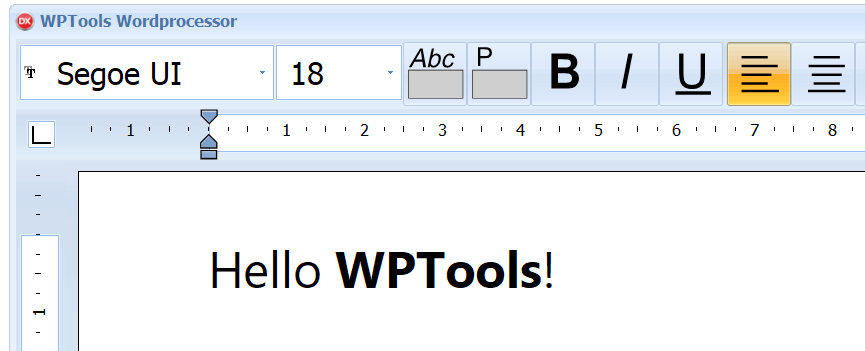
"the native Delphi Express Texter"
WPTools is a complete WYSIWYG word processing control which does not add a huge overhead to your program. It loads and saves RTF, HTML, text and its own native format. DocX import and export functionality is available as an add-on and, for PDF export, use our wPDF component.
WPTools reliably supports editable headers and footers in its page layout mode. Zooming, split-screen, tables - including the possibility of page breaks inside table rows - and a powerful concept with a CSS-like paragraph style are supported by the modern architecture.
Optional support for footnotes, columns and WPReporter is an add-on to WPTools for easily creating lists and reports. It supports nested groups as well as header and footer bands. In contrast to many other reporting solutions you can create a document that can be edited directly in the word processor.
Table Producer: Do you need to present the results of a database query to your end user in list form? Need to print a complicated list or table?
Use the dynamic tables in WPTools so that your user can browse the results of the query, change the appearance of the table.
WPTools handles tables, embedded images, header and footer texts and the usual other text attributes supported in word processing applications.
Optionally also footnotes, text boxes and columns are supported. It reads and writes its own WPT document format and also RTF, ANSI, UNICODE, HTML and optionally also DocX. Export to PDF is possible with the product wPDF.
WPTools was created to be used with Delphi and C++Builder - it is a native VCL and 100% pascal source code is available.
What makes WPTools most powerful is its architecture. Despite the architecture originates on a design invented in 2002, it is modern and versatile. The intern XML like structures support element nesting, properties (such as the indentation of a paragraph), overriding of properties and support for a non-defined state for all of the properties.
WPTools is available in different editions:
The "Standard" edition includes a lot of source code, but not the source for the internal "RTF-Engine" parts. It supports 32 bit applications only. We provide the 32bit DCU files for the current Delphi editions but also for most older ones (excluding Delphi 6, Delphi 2005 and 10.0)
The "Professional" edition includes 100% source code, also for the internal "RTF-Engine" parts and the compilation into 64 applications is possible. We also include the source files of the button glyphs in vector format (SVG). We recommend to get the full source edition since this will increase your productivity a lot. With a simple Ctrl+Click you can check each API function and see what it does, we do that with Delphi all the time.
There is also a "Bundle" - which also includes the "WPReporter" and the "TableProducer" which creates and updates tables in documents from datasets.
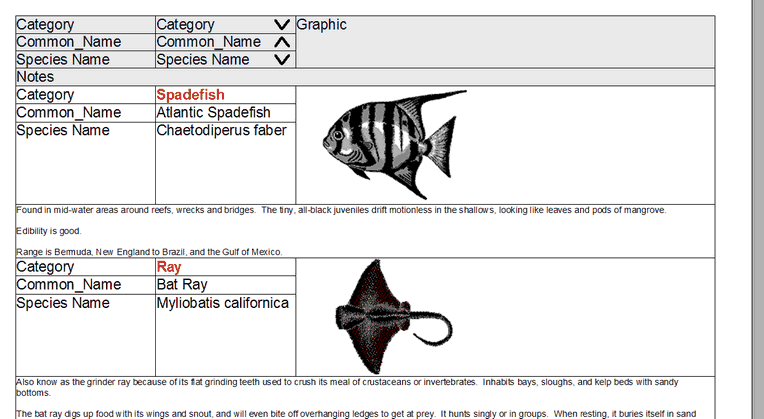
This sortable table was created by the TWPTableProducer - no code required. Unlike the usual database grids, this table is displayed as it will be printed. The user can also edit the text, add information, copy contents from the table to a word processing application. To display the result of a query which has a limited count of rows, the TableProducer can be the new and unique tool to make your application the favorite of the end user.
The "Bundle" is available as PRO and as "Standard" edition. The Premium edition also includes the WPReporter features. "WPReporter" is a unique document creation tool based on our mail-merge technology. To that technology "WPReporter" adds header and footer and group bands, they make it possible to repeat areas of the form as long as there is data to be merged in. Also included in the "bundle" is the TableProducer.
The "Premium" edition includes everything what the PRO-Bundle includes plus support for footnotes, text boxes and columns. It also includes a special XML reader and writer unit. Further more everything included in the "Bundle" (WPReporter and TableProducer) is included in the "Premium" editon.
Optionally the DocX support is available for all editions. It implements DocX reading and writing and comes with full source.
All edition include a lean but powerful XML interface (unit WPXMLInt.pas) - it makes it extremely easy to store structured information in memory with integrated support for saving and loading.
The component also comes with a set of glyphs which You may use in Your application when you have licensed WPTools. If you use Delphi XE or later, the icons are loaded as SVG and converted for the required resolution as needed using the component TWPImageList.